Choosing between the Mongolia eVisa and an embassy visa depends on your nationality, trip purpose, and how long you plan to stay. The eVisa offers a fast, fully online process for tourism and short visits — but it comes with strict limitations. The embassy visa covers every travel purpose and duration but requires more paperwork and time. This guide compares both options side by side so you can pick the right one for your trip.
What Is the Mongolia eVisa?
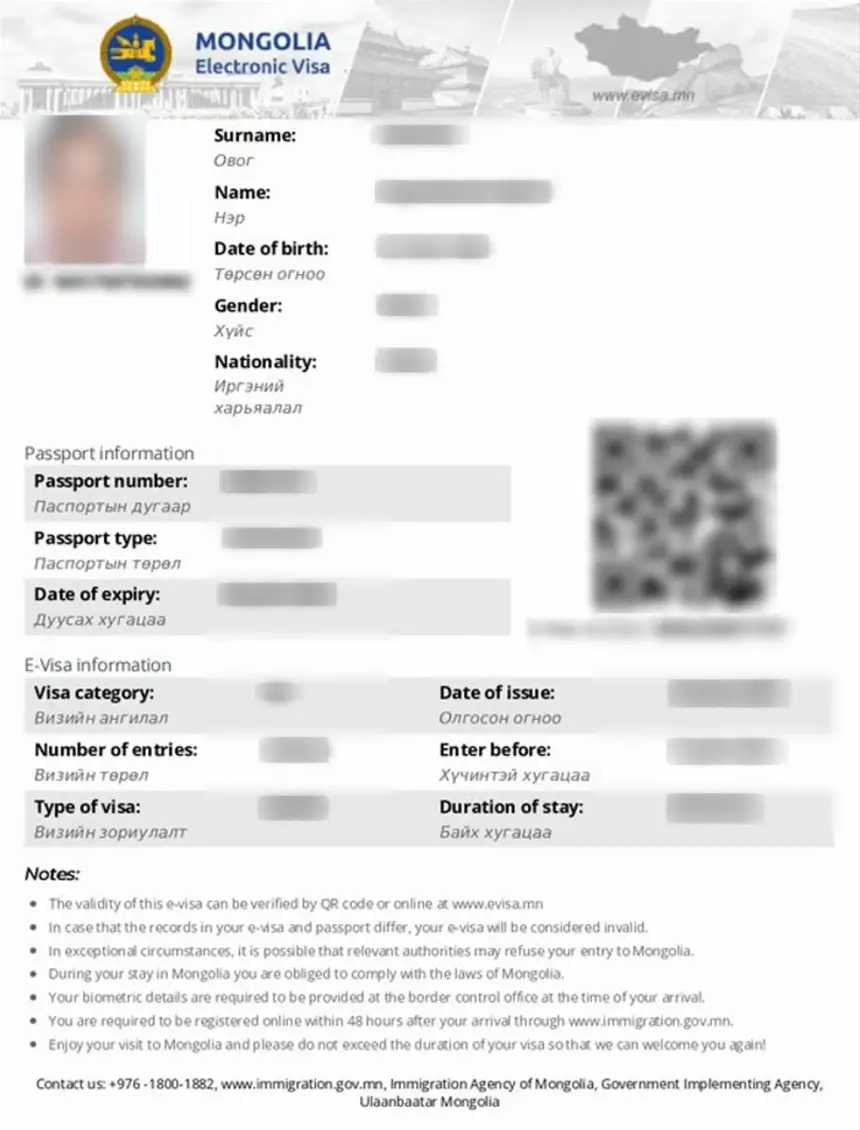
The Mongolia eVisa is an electronic travel authorization launched on October 1, 2021 through the official portal evisa.mn. Citizens of 98 eligible countries can apply entirely online — no embassy visit, no passport submission, no in-person appointment.
The eVisa system issues three visa categories for stays of up to 30 days:
- K2 — Tourism (up to 30 days)
- K4 — Cultural events, sports competitions, film/media production (up to 30 days)
- K6 — Transit (up to 10 days)
Applicants receive the approved eVisa by email within 48–72 hours. You carry a digital or printed copy to present at the airline check-in and Mongolian border control.
Key restriction: The eVisa is non-extendable and non-convertible. Once issued, you cannot extend your stay or change the visa type while in Mongolia. If you need more time or a different visa class, you must leave the country and reapply.
What Is the Mongolia Embassy Visa?
The embassy visa (also called a consular visa or sticker visa) is the traditional route. You apply at a Mongolian diplomatic mission — an embassy, consulate general, or honorary consulate — in your home country or country of residence.
Unlike the eVisa, the embassy visa covers all travel purposes, including business, study, work, family visits, religious activities, investment, and long-term stays. Embassy-issued visas can be single-entry, double-entry, or multiple-entry, with validity ranging from 90 days to 12 months.
The embassy process requires submitting your passport, application form, photo, flight itinerary, and visa fee — either in person or by mail. Processing typically takes 2–5 working days, though complex cases may take up to 10 working days.
eVisa vs Embassy Visa: Side-by-Side Comparison
| Feature | Mongolia eVisa | Mongolia Embassy Visa |
|---|---|---|
| Application method | 100% online at evisa.mn | In person or by mail at embassy/consulate |
| Eligible nationalities | 98 listed countries | All nationalities |
| Visa categories | K2, K4, K6 only | All types (K1, E, C, J, F, H, G, B, A, D) |
| Maximum stay | 30 days (10 for transit) | 30 days to 12 months |
| Entries | Single entry only | Single, double, or multiple |
| Processing time | 48–72 hours | 2–5 working days (up to 10) |
| Extendable? | No | Yes (through Immigration Authority) |
| Convertible? | No | Yes (in some cases) |
| Passport submission | Not required | Required (in person or by mail) |
| Visa permit needed? | No | Required for multi-entry and stays over 30 days |
Mongolia eVisa Categories Explained
The eVisa system limits applicants to three short-term categories. Here is what each covers:
| Category | Purpose | Max Stay | Entries |
|---|---|---|---|
| K2 | Tourism, sightseeing, visiting friends/family | 30 days | Single |
| K4 | Sports events, cultural/arts events, film/media production | 30 days | Single |
| K6 | Transit through Mongolia | 10 days | Single |
If your trip purpose falls outside these three categories — for example, business meetings, employment, study, religious work, or investment — the eVisa is not available. You must apply at an embassy.
Embassy Visa Types Available
Mongolian embassies issue a much wider range of visa types for different purposes:
| Visa Code | Purpose | Notes |
|---|---|---|
| K1 | Business | Meetings, conferences, short-term business |
| K2 | Tourism | Also available as eVisa |
| E | Student | University enrollment, academic programs |
| C | Contract worker | Employment under contract |
| J | Religious worker | Missionary, religious activities |
| F | Family/private visitor | Visiting relatives, private purposes |
| H | Private visitor | Personal visits, longer stays |
| G | Emigrant | Permanent relocation |
| B | Investor | Business investment activities |
| A | Diplomatic/official | Diplomats, government officials |
| D | Diplomat | No fee for diplomatic passport holders |
For multiple-entry visas or stays longer than 30 days, you need a Visa Permit from the Immigration Agency of Mongolia (isf.mn). A Mongolian resident, business, or government entity must request the permit on your behalf.
Processing Time: eVisa vs Embassy
| Method | Standard Processing | Maximum Processing | Expedited Option? |
|---|---|---|---|
| eVisa | 48 hours | 72 hours | No |
| Embassy (standard) | 2–3 working days | 5–10 working days | Yes (priority service at double fee) |
The eVisa is faster for straightforward tourist trips. However, the embassy offers a priority/expedited service at double the standard fee if you need a quicker turnaround on complex visa types. The embassy also processes applications on the spot in some cases when all documents are complete.
Cost Comparison: eVisa Fees vs Embassy Fees
eVisa fees vary by nationality, typically ranging from $5.50 to $51.50 USD. The fee is paid by credit or debit card during the online application.
Embassy visa fees are standardized in US dollars:
| Embassy Visa Type | Fee (USD) |
|---|---|
| Single entry (up to 90 days) | $50 |
| Double entry (up to 90 days) | $65 |
| Single transit | $25 |
| Double transit | $50 |
| Multiple transit | $75 |
| Multiple entry (up to 6 months) | $105 |
| Multiple entry (6–12 months) | $205 |
| Priority service (any type) | Double standard fee |
Note: Embassy fees are paid by money order or cashier’s check (US embassy) or bank transfer (UK embassy). Some embassies accept cash. A $5 service charge may apply at certain embassies (e.g., UK embassy).
For a simple 30-day tourist trip, the eVisa is almost always cheaper. For business, study, or long-term stays, the embassy visa is the only option — and the higher fee reflects the broader authorization.
When to Choose the eVisa
The eVisa is the right choice when:
- You are a citizen of one of the 98 eligible countries
- Your trip is for tourism, a cultural/sports event, or transit
- You plan to stay 30 days or fewer (10 days for transit)
- You want the fastest, simplest application with no embassy visit
- You do not need to extend your stay beyond the visa duration
- You are not eligible for visa-free entry to Mongolia
If you are a citizen of a visa-free country (such as the US, Canada, Germany, Japan, or South Korea), you do not need either the eVisa or an embassy visa for short tourist stays. Check our complete visa-free countries list to confirm your eligibility.
When to Choose the Embassy Visa
The embassy visa is necessary when:
- You need a visa type not available through eVisa (business K1, student E, work C, etc.)
- You plan to stay longer than 30 days
- You need a multiple-entry visa
- Your country is not on the eVisa-eligible list
- You need to extend your stay — embassy visas can be extended through the Immigration Authority in Mongolia
- You are applying for a diplomatic or official visa
- You need a visa permit for a specific purpose (work, study, investment)
Step-by-Step: How to Apply for Each
Applying for the eVisa
- Visit evisa.mn and select your visa category (K2, K4, or K6)
- Fill in personal details, travel dates, and passport information
- Upload a passport scan and a passport-size photo
- Pay the fee by credit or debit card
- Receive the approved eVisa by email within 48–72 hours
- Print or save the eVisa on your phone for presentation at the border
Applying at the Embassy
- Find your nearest Mongolian embassy or consulate
- Download and complete the visa application form
- Gather required documents: passport (6+ months validity), photo, flight itinerary, visa fee payment
- Submit in person during consular hours (typically 09:00–13:00, Mon–Fri) or by mail with a prepaid return envelope
- Wait 2–5 working days for standard processing
- Collect your passport with the visa sticker
For detailed guidance on filling out the application form, see our Mongolia visa application form guide. To check processing timelines, visit our processing time breakdown.
Common Mistakes to Avoid
- Applying for an eVisa when you need a work or student visa. The eVisa only covers tourism, cultural events, and transit. If your purpose is business, study, or employment, you must go through the embassy.
- Assuming the eVisa can be extended. It cannot. If you overstay, you face fines and potential denial of exit. Plan your dates carefully.
- Not checking visa-free eligibility first. Citizens of 65+ countries (31 permanent + 34 temporary through 2026) can enter Mongolia without any visa for 30–90 days. Applying for an eVisa when you are visa-free is unnecessary.
- Waiting until the last minute. While eVisa processing is fast (48–72 hours), embassy processing can take up to 10 working days. Apply at least 3–4 weeks before departure.
- Forgetting the registration rule. Foreign nationals staying 30+ days must register with the Immigration Authority within 7 days of arrival. Failure to register results in fines and denial of exit.
Frequently Asked Questions
Does Mongolia have an eVisa?
Yes. Mongolia launched its Electronic Visa Application System on October 1, 2021 at evisa.mn. Citizens of 98 countries can apply for K2 (tourism), K4 (cultural/sports events), and K6 (transit) visas entirely online.
Which is better — Mongolia visa or eVisa?
For a short tourist trip of 30 days or fewer, the eVisa is faster and cheaper. For business, study, work, or stays longer than 30 days, the embassy visa is the only option. The “better” choice depends entirely on your trip purpose and duration.
What is the difference between the Mongolia eVisa and an embassy visa?
The eVisa is applied for entirely online and covers only tourism, cultural events, and transit (up to 30 days). The embassy visa requires visiting a Mongolian diplomatic mission but covers all visa types and durations, including business, work, study, and multi-entry visas valid up to 12 months.
How long does it take to get a Mongolia eVisa?
The eVisa is processed within 48–72 hours after submission. You receive the approved visa by email. There is no expedited option — all applications follow the same processing timeline.
How long does it take to get a Mongolia embassy visa?
Standard embassy processing takes 2–5 working days. Complex applications or those requiring additional documents may take up to 10 working days. Some embassies offer priority processing at double the standard fee.
Can I extend a Mongolia eVisa?
No. The Mongolia eVisa is non-extendable and non-convertible. If you need to stay longer, you must leave Mongolia and apply for a new visa — either a new eVisa or an embassy visa with the appropriate category.
What are the categories of Mongolia eVisa?
There are three eVisa categories: K2 for tourism (up to 30 days), K4 for sports, cultural events, and film/media production (up to 30 days), and K6 for transit (up to 10 days). All are single-entry.
Do US citizens need a visa for Mongolia?
No. US citizens can enter Mongolia visa-free for up to 90 days since July 18, 2001. A valid passport with at least 6 months of validity is required. For stays longer than 90 days or for non-tourism purposes (work, study), a visa from the embassy is required.
How much does the Mongolia eVisa cost?
eVisa fees vary by nationality, typically ranging from $5.50 to $51.50 USD. The fee is paid online by credit or debit card during the application at evisa.mn. Embassy visa fees start at $25 for transit and $50 for single entry.
Is the Mongolia eVisa the same as a visa on arrival?
No. Mongolia does not offer visa on arrival. The eVisa must be applied for and approved before you travel. You receive it by email and present it at the border. There is no option to obtain a visa at the airport or land border crossing.
Related Guides
- Mongolia Visa Requirements: Everything You Need to Know
- Mongolia Visa Processing Time: How Long Does It Take?
- Mongolia Visa Application Form: Download & How to Fill
- Mongolia Visa Status Check: Track Your Application Online
- Mongolia Visa-Free Countries: Complete List (2026)
- Mongolia Visa for US Citizens: Complete 2026 Guide